In Hinduism[edit]
In the Vedas[edit]
Varuna and Mitra are the gods of the societal affairs including the
oath, and are often twinned
Mitra-Varuna (a
dvandva compound). Varuna is also twinned with
Indra in the Rigveda, as
Indra-Varuna (when both cooperate at New Year in re-establishing order
[5]).
Both Mitra and Varuna are classified as
Asuras in the Rigveda (e.g.
RV 5.63.3), although they are also addressed as
Devas as well (e.g.
RV 7.60.12). Varuna, being the king of the Asuras, was adopted or made the change to a Deva after the structuring of the primordial cosmos, imposed by Indra after he defeats Vrtra.
[7]
Vedic
Varuna is sometimes thought to be a reflex of the same
Proto-Indo-European theonym as Greek
Ouranos, based on similarities between both names and the respective gods' attributes, but no successful derivation has yet been produced that is consistent with known laws of sound change.
[8]
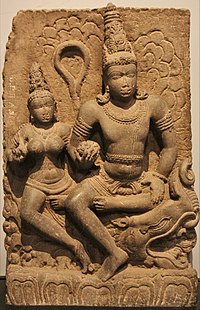
Varuna with Varunani. Statue carved out of
basalt, dates back to 8th century CE, discovered in Karnataka. On display at the
Prince of Wales museum, Mumbai.
In the Ramayana[edit]
Faced with the dilemma of how to cross the ocean to
Lanka, where his abducted wife
Sita is held captive by the demon king
Ravana,
Rama (an
Avatar of
Vishnu) performs a penance (
tapasya) to Varuna, the Lord of Oceans, fasting and meditating in perfect
dhyana for three days and three nights. Varuna does not respond, and Rama arises on the fourth morning, enraged by the God's arrogance. With his bow and arrow, he angrily begins attacking the oceans with celestial weapons—burning up the waters and killing its life and creatures. The Vanaras (Monkeys) are dazzled and fearful at witnessing the enraged Rama demolish the oceans, and his brother,
Lakshmana, prays to calm Rama's mind. Just as Rama invokes the
brahmastra, considered the most powerful weapon capable of destroying all creation, Varuna arises out of the oceans. He bows to Rama, explaining that he himself was at a loss to answer Rama's question. Begging him not to destroy the oceans with the missile, he suggests that Rama re-direct the weapon at a demonic race that lives in the heart of the ocean. Rama's arrows destroys the demons, and establishes a purer, liberated environment there. Varuna promises that he would keep the oceans still for all of Rama's army to pass, and Nala constructs a bridge (
Rama's Bridge) across to Lanka. Rama justifies his angry assault on the oceans as he followed the correct process of petitioning and worshipping Varuna, but obtaining the result by force for the greater good.
[9] Varuna is a king and is known to have some asura attendants or followers as well. Meghavasas was an asura minister in Varuna's assembly.
[10]

Manora Island Beach, with Varun Dev Temple visible in the top right corner, Manora Beach, Karachi, Pakistan
In Zoroastrianism[edit]
Also unrelated to Vedic Varuna are Avestan
Vourukasha and
Varena. The former is the Avesta's mythological sea that covers the earth, while
Varena is a mythological four-cornered fourteenth region of the world.
In Buddhism[edit]
In the Buddhism of the Far East, Varuna is one of the twelve Devas, as guardian deities, who are found in or around Buddhist shrines (
Jūni-ten, 十二天).
[11] In Japan, Varuna had been called "Suiten" in
Japanese buddhism.
[12]Varuna joins these other eleven Devas of Buddhism, found in Japan and other parts of southeast Asia: Indra (Taishaku-ten), Agni (Ka-ten), Yama (Emma-ten), Nirrti (Rasetsu-ten), Vayu (Fu-ten), Ishana (Ishana-ten), Kubera (Tamon-ten), Brahma (Bon-ten), Prithvi (Chi-ten), Surya (Nit-ten), Chandra (Gat-ten).
[13][14]
In Shintoism[edit]
In modern age[edit]

Varuna, the Indian Neptune, USS Varuna (1861) & USS Varuna (1943)
See also[edit]


No comments:
Post a Comment